Need Help? Get in touch with us Call
Follow Us



Need Help? Get in touch with us Call
Follow Us

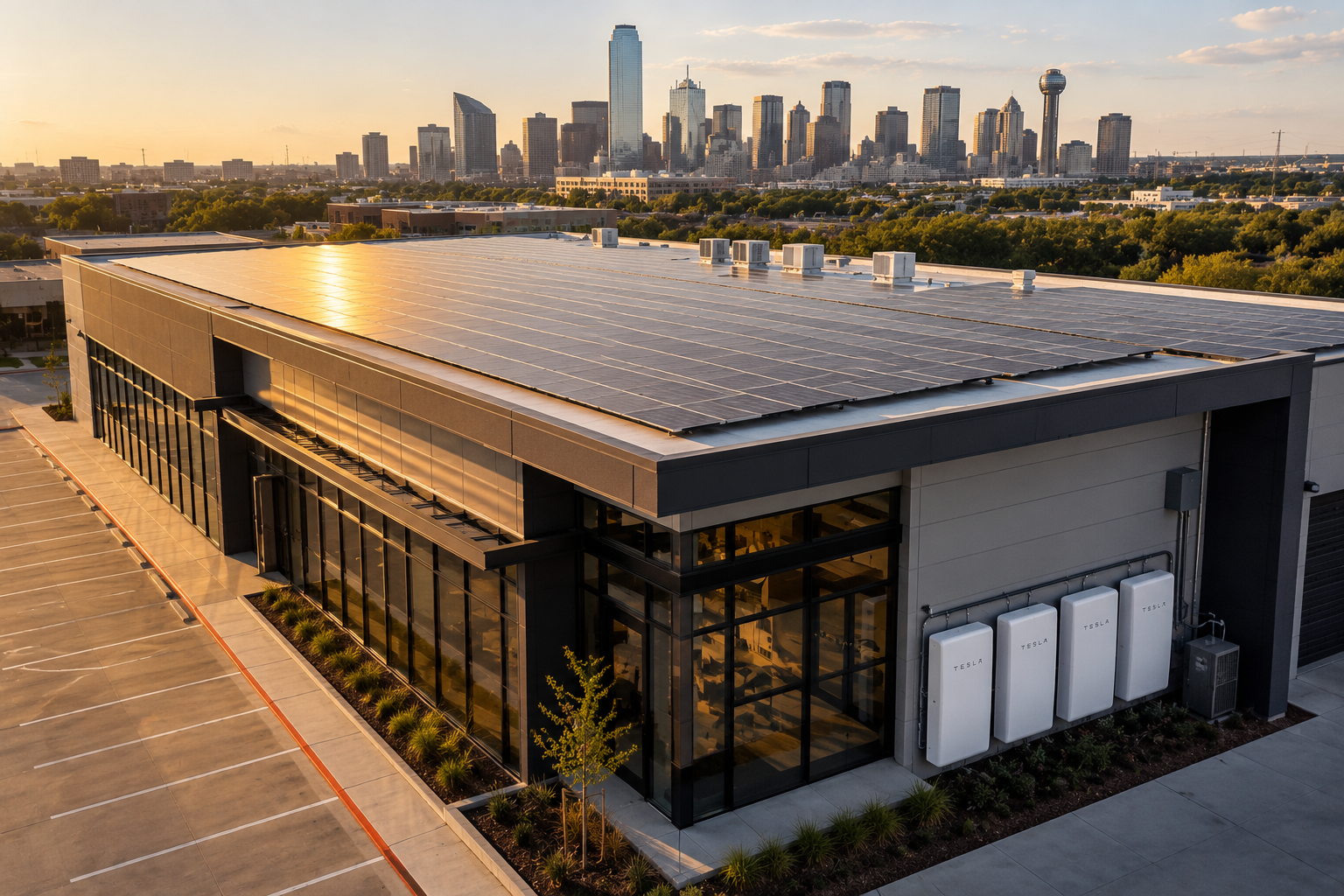
For Dallas business owners, energy reliability is not a luxury; it is a necessity. As electricity costs continue to climb and the Texas grid faces seasonal pressure, more commercial properties across the DFW metroplex are turning to solar energy to take back control of their power supply. And at the center of that strategy are commercial solar batteries, a critical component that transforms a standard solar setup into a true energy independence solution.
Solar generation alone gets you part of the way there. Battery storage gets you the rest.
Dallas businesses operate in one of the most energy-intensive environments in the country. Texas summers frequently surpass 100°F, with Dallas averaging dozens of triple-digit days per year, sending commercial HVAC systems and electricity demand through the roof. The Electric Reliability Council of Texas (ERCOT), which manages the state’s grid, has faced well-documented strain during extreme weather events, leaving businesses vulnerable to price spikes and outages.
For commercial operations, even a few hours of unplanned downtime can mean lost revenue, missed service commitments, and damage to client relationships. That is why energy independence has become a strategic priority, not just an environmental one.
When a business relies entirely on the grid, it absorbs all of that uncertainty. A commercial solar system paired with battery storage changes that equation fundamentally.
A commercial solar installation generates electricity during daylight hours. Without storage, that energy either gets used immediately or gets exported to the grid through solar buyback plans, sometimes at rates that do not fully offset what the business pays to draw power at night or during peak demand windows.
Solar batteries solve this by capturing excess generation during the day and storing it for use later. The business can then draw from that stored energy rather than the grid when rates are highest or when the grid experiences stress events.
In commercial applications, this process is managed by an energy management system (EMS) that automates when to charge, when to discharge, and when to draw from the grid, optimizing for both cost savings and reliability simultaneously.
 Energy storage: Captures surplus solar generation for use during off-sun hours
Understanding these functions is important because they each contribute differently to a business’s bottom line, and a well-designed system accounts for all of them.
Let’s be direct: the investment in commercial solar battery storage needs to make financial sense. For most Dallas businesses, it does and increasingly so as battery technology improves and costs come down.
The financial case rests on a few key pillars. First, demand charges. Many commercial utility accounts in Texas are billed partly on their peak demand, the highest amount of power drawn from the grid at any single point during the billing period. This charge can account for a significant share of a commercial electricity bill. Battery systems can discharge during those peak moments, capping the draw from the grid and reducing that charge substantially.
Second, time-of-use optimization. By storing cheap daytime solar energy and using it during expensive evening hours, commercial properties can manage their effective electricity rate more strategically than businesses that draw everything from the grid in real time.
Third and often underestimated is business continuity. A warehouse, restaurant, medical office, or logistics facility that loses power for even a few hours can face costs far exceeding the battery system investment. Backup capability provides real financial protection.
Businesses considering commercial solar panels should factor battery storage into their initial design. Retrofit installations are possible but tend to cost more than integrated systems from the start.
Working with a qualified solar partner to install a commercial battery system involves several distinct phases. Understanding what those phases look like helps business owners plan accurately and avoid surprises.
A proper site assessment comes first. The installer evaluates the facility’s energy consumption patterns, existing electrical infrastructure, available roof or ground space, and utility interconnection requirements. This data shapes the system design, both the solar array and the battery capacity.
For facilities with substantial roof space or properties with available land, commercial ground mount solar provides an alternative to rooftop installations and may support larger battery systems. Ground mount arrays can be oriented and tilted for maximum generation, often outperforming rooftop setups in raw output.
After installation, commercial systems require periodic maintenance to ensure they perform as designed. Light Switch Solar’s commercial solar repair and maintenance services keep systems operating at peak efficiency, which directly affects the ROI of both the panels and the battery storage.
A properly scoped and installed commercial battery system is not a set-it-and-forget-it piece of equipment. It is an active asset that, when maintained correctly, continues to deliver measurable value year over year.
Beyond immediate cost savings and backup reliability, commercial solar battery systems deliver compounding benefits over their operational lifespan, which typically extends 10 to 15 years for the batteries, and 25 or more for the solar panels themselves.
Tenant attraction is one benefit that commercial real estate owners frequently cite. In the DFW market, tenants particularly those with ESG (environmental, social, and governance) reporting obligations, increasingly prefer facilities with on-site renewable generation and storage. A building that can demonstrate lower operating costs and verified sustainability credentials commands a stronger leasing position.
Carbon footprint reduction is another long-term benefit. Dallas businesses that are working toward sustainability goals or responding to client-driven procurement requirements can use solar battery data to document real reductions in grid-sourced electricity consumption.
Finally, energy security continues to grow in strategic value as weather events become more unpredictable across Texas. A commercial facility that can island itself from the grid during a disruption, keeping refrigeration, security, lighting, and communications running, is not just more resilient. It is more competitive.
To explore options tailored to your facility’s size and energy profile, the commercial services team at Light Switch Solar can walk you through a system design based on your actual usage data.
Commercial solar battery storage is one of the most effective tools available to Dallas businesses that want to control their energy costs, protect their operations, and build toward long-term sustainability. If you’re ready to see what the right system could look like for your facility, reach out to us for a free consultation and custom assessment.
Yes. Battery storage can often be added to an existing commercial solar installation, though the complexity and cost depend on the inverter type already in place. Some systems require a hybrid inverter upgrade to support battery integration. A site assessment will determine whether retrofit is straightforward or requires additional infrastructure changes.
Duration depends on battery capacity and the loads being supported. A system designed for full-facility backup will require significantly more storage than one designed to keep critical systems, servers, refrigeration, and security operational during a grid outage. Most commercial systems are designed around specific critical load requirements, with runtime typically ranging from several hours to a full day or more depending on capacity.
Battery systems paired with solar installations may qualify for the federal Clean Electricity Investment Tax Credit (formerly known as the ITC, now under Section 48E), which offers up to 30% of eligible system costs. Commercial projects under 1 MW automatically qualify for the full 30% rate; larger projects must meet prevailing wage and apprenticeship requirements to achieve the same rate. Dallas businesses should consult a tax advisor regarding eligibility and current requirements, as the rules have been updated in recent legislation. Light Switch Solar can provide documentation to support your tax filing.
Texas utility billing for commercial accounts often includes demand charges based on peak consumption. Battery systems reduce peak draw by discharging stored energy during high-demand periods, directly lowering those charges. Unlike states with mandatory net metering, Texas uses solar buyback plans where each Retail Electric Provider (REP) sets its own export credit rate, so the financial interaction between battery storage and any solar export credits should be reviewed on a provider-by-provider basis.
Address
Houston, TX
Phone No:




 May 28th 2026